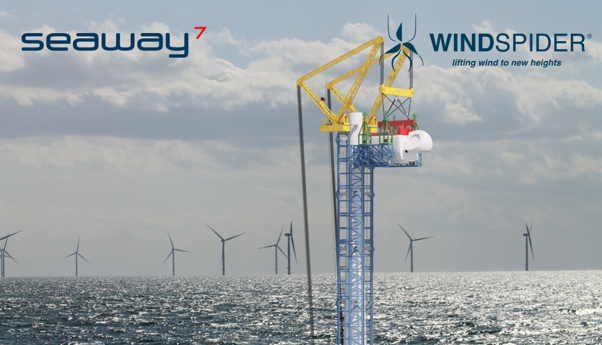
As deep-water bottom-fixed and hybrid foundation technologies advance, new offshore wind areas are becoming accessible for development. WindSpider's modular lifting system is designed to support the installation and maintenance of the large turbines needed to make these projects a reality.
WindSpider — an enabler for a new frontier in offshore wind
September 15, 2026
As deep-water bottom-fixed and hybrid foundation technologies advance, new offshore wind areas are becoming accessible for development. WindSpider's modular lifting system is designed to support the installation and maintenance of the large turbines needed to make these projects a reality.
Traditionally, the logic has been relatively straightforward: conventional Bottom-Fixed (B-F) foundations dominate in shallow waters; beyond 70 - 75 m of depth, floating becomes the natural solution.
Recently, however, this distinction has been challenged with several emerging concepts that explore ways of taking B-F or hybrid foundations into water depths previously considered the domain of floating wind and hence opens vast offshore areas with favorable wind conditions.
However, to reach these areas a new cost-effective and robust method for WTG installation and MCR is needed, as they are outside water depths for traditional jack-up vessels. This issue is solved by using WindSpider technology.
How do we install and maintain wind turbines on those deep-water foundations economically?
New deep-water, bottom-fixed foundations are intended to support some of the largest WTGs ever deployed, often in water depths where installation with conventional jack-up vessels becomes increasingly demanding.
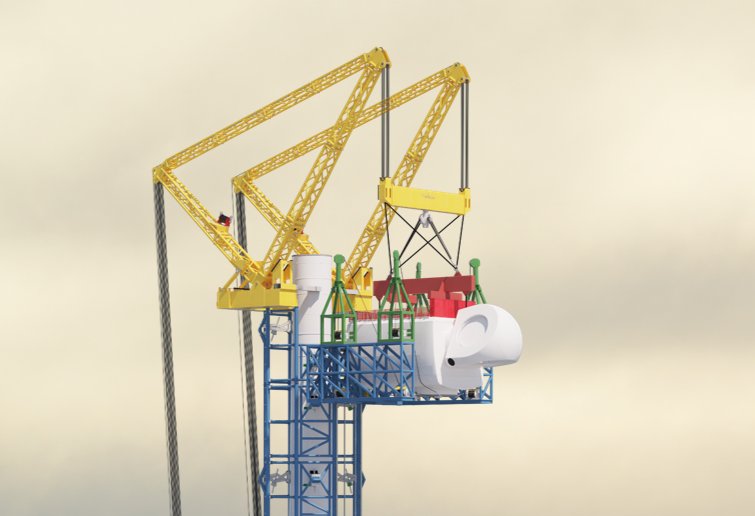
This issue is solved by WindSpider, a modular lifting system capable of handling very large turbines that could provide a different installation strategy — one that utilizes the turbine tower for support, without requiring the installation vessel itself to grow in size and lifting capacity.
WindSpider’s WS-1200 is designed specifically for the installation of +13 MW turbines, with a lifting capacity of 1200 tonnes and a lifting height exceeding 200m. The system uses the WTG tower as part of the lifting structure, allowing the heavy-lift capability to scale with the turbine rather than with the installation vessel. This opens the possibility of using a much wider range of vessels — including existing monohull heavy lift vessels.
Vast areas for deep-water bottom-fixed
Recent TGS | 4C’s analysis, published at Wind Europe earlier this year, examined offshore wind resources in 60–400 m water depth range and challenged the status quo of the B-F vs floating division. Their analysis estimated that more than 70% of global wind resources have traditionally been associated with floating wind, but that share could fall as hybrid and deep-water fixed-bottom technologies mature.

Promising foundation technologies
Several recent articles, including those from Recharge and Riviera, have highlighted a growing number of deep-water fixed-bottom and hybrid solutions. Among them are the Articulated Wind Column by AWC Tech/ODE, PelaFlex GS by Marine Power Systems, FTLP+ by OSI Renewables, Neretek BC90 by Neretek, and the Fully Restrained Platform by Entrion Wind, with developers such as SSE Renewables and CIP exploring their potential.
Promising cheaper deep-water wind, these technologies appear to be more than a collection of interesting engineering concepts. We believe these technologies have the potential to open up areas in water depths between 75 m and 150 m, creating a substantial new frontier for fixed-bottom and hybrid solutions and potentially reshaping the economics of fixed versus floating wind.

Near-term auction award
With the UK now adjusting its policy framework to create a new Other Deepwater Offshore Wind (ODOW) category, allowing these hybrid and deep-water solutions to compete for Contracts for Difference (CfD) support, the shift is beginning to look less like a possibility and more like an emerging reality. The auction strike price for this category is set at the same level as for floating wind £271/MWh.
The new category is being put to the test in the UK’s eighth CfD Allocation Round (AR8), with auction results expected around New Year and no later than March 2027.
Sources and further reading (updated 01.10.2026):
- https://www.linkedin.com/feed/update/urn:li:activity:7511312006969303040
- Riviera - News Content Hub - Floating wind ‘no longer the default option’ for deepwater windfarms
- New Deep-Water Offshore Wind Analysis Debuts at WindEurope 2026
- https://www.rechargenews.com/analysis/uk-renewables-auction-six-key-takeaways-from-government-announcements/2-1-2013865
- New foundations promise cheaper UK deepwater wind | Recharge
- www.neretek.com